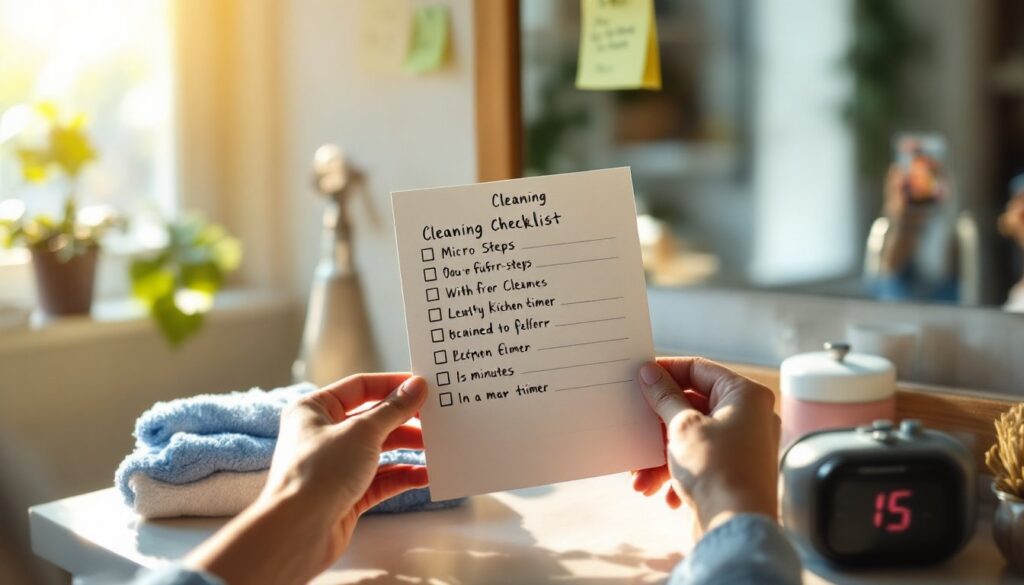
Living with ADHD often means that cleaning feels overwhelming, not because someone doesn’t care about their space, but because the traditional cleaning schedule (Monday for bathrooms, Wednesday for floors, Sunday for laundry) requires executive function that ADHD brains struggle to sustain. An ADHD house cleaning schedule needs to work differently. Instead of pushing through willpower or shame, a cleaning schedule for ADHD should leverage how attention and motivation actually work in an ADHD brain: in bursts, with flexibility, and with plenty of external structure. This guide walks through practical strategies for building a sustainable cleaning routine that fits reality, not Instagram.
Key Takeaways
- An effective ADHD cleaning schedule breaks large tasks into micro-steps (5–10 minutes each) to eliminate decision fatigue and trigger small dopamine wins through completion.
- Time-boxing with a 15–20 minute timer and body doubling (cleaning alongside others) provides external structure that ADHD brains need to initiate and sustain tasks.
- Rotate cleaning zones weekly rather than assigning fixed days, allowing flexibility to clean during high-energy periods while removing the shame of missed deadlines.
- An ADHD cleaning schedule prioritizes ‘good enough’ consistency over perfection—maintaining a functionally clean space through frequent small efforts beats monthly deep cleans followed by decline.
- Immediate rewards after task completion, removing decision friction through designated item homes, and tracking progress without shame are essential to sustaining long-term cleaning routines with ADHD.
Why Traditional Cleaning Schedules Fail People With ADHD
The standard cleaning schedule, cleaning bathrooms on Tuesday, vacuuming on Thursday, deep-cleaning the kitchen on Saturday, assumes steady motivation and consistent executive function across days. For people with ADHD, this assumption breaks down quickly.
Traditional schedules demand sustained focus on a single task category across an entire day. They also rely on remembering which day is assigned to what, a task that requires working memory and consistent time awareness. When someone misses a day, shame and procrastination often follow. The schedule becomes another source of guilt instead of a tool.
An ADHD brain often works in hyperfocus bursts, periods where focus feels effortless, followed by crashes where even small tasks feel impossible. A rigid cleaning schedule doesn’t account for these cycles. Someone might have incredible energy to clean on Tuesday but be mentally drained by Thursday. Forcing tasks on “schedule” instead of during natural energy peaks sets up repeated failure.
Research on ADHD and executive function shows that external structure, novelty, and immediate reward are more effective motivators than self-imposed rules. A traditional calendar on the fridge doesn’t trigger dopamine in the same way that, say, completing a 15-minute timed challenge or getting validation from a friend does. The schedule itself isn’t broken, the approach is just mismatched to how ADHD brains function.
Design a Cleaning Schedule That Works With Your Brain
Building an ADHD house cleaning schedule that actually sticks means abandoning rigid day assignments in favor of flexible task structure, time-based boundaries, and built-in rewards.
Breaking Tasks Into Micro-Steps
One of the biggest reasons cleaning feels overwhelming is that “clean the bathroom” or “tidy the living room” are too vague. ADHD brains get stuck at the planning stage and may never start. Breaking these large tasks into specific, concrete micro-steps removes the decision fatigue.
Instead of “clean the bathroom,” the list becomes: (1) Clear items off the counter into a basket. (2) Spray and wipe the counter. (3) Wipe the mirror. (4) Spray and wipe the toilet. (5) Spray and let the shower sit for 2 minutes, then wipe. (6) Sweep and trash. Each micro-step should take 5–10 minutes max and have a clear start and end point.
Create these lists once and post them where they’re visible, laminated on the bathroom mirror, on a sticky note by the kitchen, or in a notes app on the phone. This eliminates daily decision-making. Someone with ADHD can look at the list, pick one micro-step, and do it. A cleaning schedule for ADHD thrives on this specificity.
Another benefit: micro-steps create small wins. Completing one step and checking it off triggers a small dopamine hit. Momentum builds, and often someone will continue to the next step without the painful startup effort of beginning from scratch.
Using Time Blocks and Body Doubling
Time-boxing, setting a timer for 15 or 20 minutes and completing whatever cleaning fits into that window, works exceptionally well for ADHD brains. The timer creates external structure and a clear endpoint. People often underestimate what they can finish in a focused burst, so the task feels easier when it’s bounded.
Body doubling, the practice of cleaning alongside another person, either in the same room or via video call, is powerful for ADHD individuals. The presence of another person activates accountability and often makes the task feel less lonely and more game-like. Some people use video calls with friends (both cleaning at the same time in their own spaces) or family members in the home. Others hire a cleaner for 2 hours just to have someone else present while they tackle their own space: the external structure helps initiate tasks they’d otherwise avoid.
A hybrid approach combines both: Set a 20-minute timer, start a video call with a friend who’s also cleaning, and work through one micro-step or a section of the home. The time boundary removes the fear of losing an entire afternoon, and the social element provides motivation beyond willpower.
Sustainable Systems for Long-Term Success
An ADHD cleaning schedule only works if it’s sustainable, which means building in flexibility, reducing friction, and creating positive associations with cleaning rather than shame.
Remove unnecessary decisions. Assign homes for frequently-used items (keys on a hook by the door, clean clothes in one drawer, work supplies in one basket). When things have designated spots, tidying becomes a fast, mindless task rather than a decision puzzle.
Rotate task focus, don’t assign days. Instead of “Monday is bathroom day,” use a card system or phone reminder that rotates through cleaning zones (kitchen, bathroom, bedroom, living room, laundry). On high-energy days, clean the zone highlighted that week. On low-energy days, do one micro-step from that zone or skip it entirely. There’s no failure, only flexibility.
Use a timer as the main measure, not perfection. The goal isn’t a magazine-ready home: it’s that a space is functionally clean for 15–20 minutes of effort. If dishes get done and floors are swept, that’s a win. Perfectionism kills consistency in ADHD routines faster than anything else.
Build in immediate rewards. Completing a 20-minute cleaning session earns a break, snack, episode of a show, or whatever provides genuine dopamine. This isn’t frivolous, it’s essential neurochemistry for ADHD brains. Link the reward tightly to the task completion so the brain learns: cleaning → good feeling.
Track differently. Instead of a calendar with X’s (visual proof of “failure” if dates are missed), use a simple tally or point system. No shame attached, just data. Many people with ADHD find it helpful to use apps designed for ADHD (like Habitica, which gamifies tasks, or even a shared to-do list with a friend who checks in).
Embrace “good enough.” A home maintained at 70% cleanliness through consistent micro-actions beats a home that’s perfect once a month and a disaster the rest of the time. ADHD brains thrive on routine and frequent small wins over rare, exhausting marathons. An ADHD cleaning schedule that works is one that accepts this and builds around it.
Adjust seasonally or when life changes. ADHD medication changes, work schedules, or seasonal mood shifts will affect energy. The schedule shouldn’t be sacred. If the current system stops working, pause, reassess, and redesign. This isn’t failure: it’s smart adaptation.
Conclusion
An ADHD house cleaning schedule isn’t about fitting into a neurotypical mold of what “clean” looks like. It’s about creating a system that works with ADHD brains, one built on micro-steps, time-boxing, external structure, and honest self-knowledge. When the schedule aligns with how attention actually works, cleaning stops being a source of shame and becomes a manageable, even rewarding, part of daily life.