Your front yard is the first impression visitors get, and trees are one of the fastest ways to lift that curb appeal. A well-placed tree doesn’t just look good: it adds shade value, increases property appeal, and can boost your home’s resale potential. But, slapping down any tree anywhere won’t cut it. Strategic tree landscaping requires understanding your climate, soil, and the specific role each tree will play in your yard’s overall design. This guide walks through seven proven tree landscaping ideas that work across different regions and budgets, helping you create a front yard that actually looks intentional and functions year-round.
Key Takeaways
- Front yard tree landscaping ideas require matching tree species to your USDA hardiness zone and soil type to ensure long-term health and survival.
- Layering trees of different heights and canopy shapes creates visual depth and makes your home feel intentionally designed rather than randomly placed.
- Strategic tree placement—including shading decisions and foundation distance—can reduce cooling costs by 20-30% while protecting your home’s structural integrity.
- Dense evergreen trees planted in staggered rows serve as natural privacy screens that add real estate value faster than fences.
- Flowering trees like crabapple, redbud, and magnolia deliver seasonal color and visual interest with minimal ongoing maintenance when placed in 6+ hours of direct sunlight.
- Soil preparation and consistent watering during the first 2-3 years significantly increase tree establishment rates and long-term landscape success.
Choose Trees That Match Your Climate and Soil
Before you buy a single sapling, know your USDA hardiness zone and soil type. A beautiful magnolia won’t survive a Minnesota winter, and a drought-tolerant desert oak will struggle in soggy Georgia clay. Dig a simple soil test pit: dig a hole about 12 inches deep, fill it with water, and see how fast it drains. Fast drainage (within minutes) means sandy soil: slow drainage (hours) signals clay. Most trees prefer well-draining loam, a balance of sand, silt, and clay, but plenty of tough options exist for problem soils.
Standard choices include oak (hardy, long-lived, moderate shade), maple (fall color, adaptable), and ash (fast-growing, upright form). For warmer zones, crepe myrtle, live oak, and crape myrtle deliver year-round interest. If your soil is compacted or poor, amend it before planting: mix in 3 to 4 inches of compost and work it into the top 12 inches of the planting hole. This matters more than the tree itself: most young trees fail due to poor soil prep, not poor genetics.
Local nurseries are your best resource. Staff can recommend species that thrive in your exact neighborhood, not just your zone. They’ll also know which trees are prone to local pests or diseases. Ask about mature size: a “shade tree” might grow 50 feet tall and 40 feet wide. That’s beautiful in 15 years but cramped if you’ve only got 30 feet of front yard.
Create Visual Interest With Layered Tree Plantings
A single tree in the middle of a flat lawn looks lonely. Layering, planting trees of different heights and canopy shapes, creates depth and draws the eye. The standard formula is understory trees (20–35 feet tall) in the background, mid-story trees (15–25 feet) in the middle ground, and accent shrubs or smaller ornamental trees (8–15 feet) in the foreground.
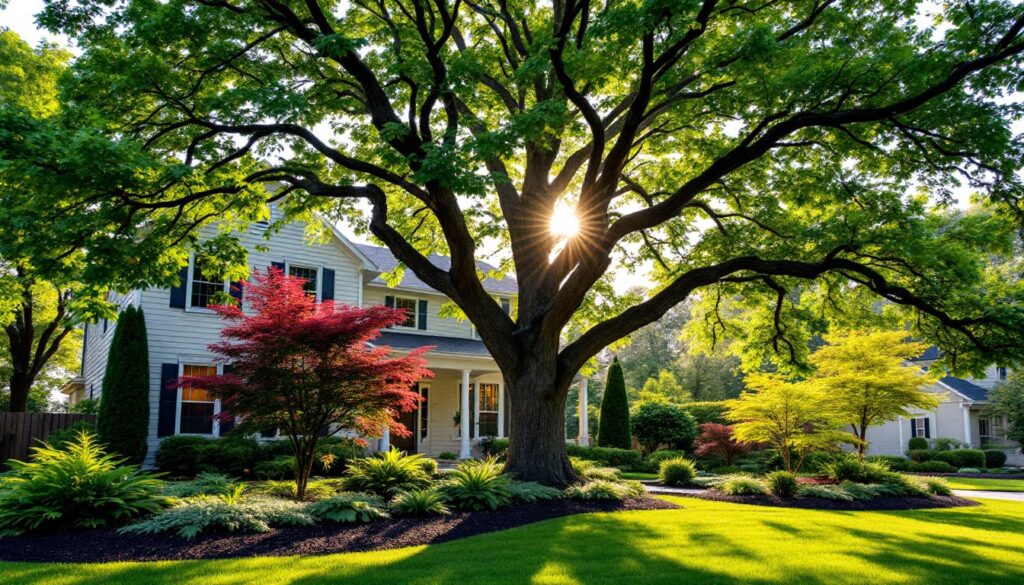
For example: Plant a large shade tree like a white oak (60+ feet at maturity) 30 feet back from the street, a medium serviceberry or redbud (25 feet) in the middle, and ornamental dogwood or Japanese maple (15–20 feet) closer to the house. This creates a natural frame that makes your home feel nested in landscape, not dropped into it. The smaller trees also soften the foundation and hide the base of the larger shade tree, which develops an ungainly bare lower trunk as it grows.
Stagger the plantings, don’t line them up. Offset trees by at least 8–10 feet horizontally so they don’t compete for light and water. When selecting multiple trees, vary their shapes: pair columnar (narrow, upright) trees like emerald arborvitae with spreading, broad-canopy trees like red maple for visual contrast. Different bloom times and fall colors add seasonal interest too.
Use Trees as Natural Privacy Screens
If your front yard faces a busy street or neighboring windows, a privacy screen of trees beats a fence, and adds real estate value. Dense, fast-growing evergreen trees are the workhorses here: Canadian hemlock, emerald arborvitae, Leyland cypress, and blue spruce all stay green year-round and block sight lines.
Plant screen trees in a staggered double or triple row, 5–8 feet apart, depending on the tree’s mature spread. A single row of columnar evergreens spaced 8 feet apart will create a privacy barrier in 5–7 years. A double row (staggered, so trees in the back offset from the front) fills in faster and looks more intentional. Keep in mind: hemlock and some spruces prefer cool climates, while cypress thrives in warmer zones. Always check local suitability before committing.
Note that privacy screening is often a multi-year project. Young trees grow quickly, but the first 2–3 years are slow. Mulch heavily (3 inches, kept 6 inches away from the trunk) and water consistently during the first two seasons to speed establishment. A drip irrigation line is worth the investment for large screens.
Frame Your Home’s Entrance With Strategic Placement
The trees flanking your front door, or visible in the approach to your house, set the tone. Pair symmetrical trees (identical species and size on either side) for a formal, welcoming look. Two columnar hornbeams, arborvitae, or crabapples work beautifully here. The trees should be tall enough to frame the door without blocking it (typically 20–25 feet at maturity, but placed far enough back that mature canopy won’t overhang the roof).
For a softer, cottage feel, plant asymmetrical groupings: a medium shade tree on one side and an understory accent tree on the other. This feels less rigid and works better with modern or farmhouse aesthetics. Ensure that tree placement doesn’t interfere with roof overhangs, gutters, or foundation walls. A general rule: plant a shade tree at least as far from the house as its mature height. A tree that grows to 40 feet should start 40+ feet away.
Consider sightlines too. Avoid blocking the front door or windows from the street, and don’t shade solar panels if you have them. Trees planted too close create humidity and reduce air circulation around the foundation, a long-term moisture problem.
Incorporate Flowering Trees for Seasonal Color
Flowering trees deliver color payoff for minimal ongoing work. Crabapple (spring pink or white blooms, fall fruit), redbud (purple-pink spring flowers), magnolia (late winter to spring blooms), and serviceberry (white spring flowers, edible berries, red fall foliage) are reliable across many regions. For warmer zones, dogwood, ornamental cherry, and eastern redbud shine.
Plant flowering trees in spring or early fall so they establish roots before their peak bloom season. Most need 6+ hours of direct sun to flower well. Avoid planting under power lines: select trees with a mature height at least 8–10 feet below the lowest wire. Most flowering ornamentals don’t need heavy pruning, just remove dead or crossing branches in late winter before growth starts.
Be aware that some flowering trees (crabapples, certain cherries) attract attention from pests or disease, but newer cultivars are bred for disease resistance. Ask your nursery for resistant varieties. Also, some (like flowering cherries) are short-lived compared to oaks or maples: expect 20–30 years rather than 50+, but the seasonal show is worth it for many homeowners.
Design Shade Solutions That Add Year-Round Value
Shade from a large tree can reduce cooling costs by 20–30% if positioned on the western or southwestern side of the house. Deciduous shade trees (oak, maple, ash) lose leaves in winter, letting winter sun warm the south and west sides. Placement matters: a tree 15–20 feet to the west can shade afternoon sun without blocking winter solar gain.
For year-round shade, use semi-deciduous or evergreen trees. Live oak (in warm zones) and Southern magnolia provide dense, persistent cover. Plant shade trees far enough from the house so their mature canopy doesn’t trap moisture against siding or gutters, the standard rule is mature tree height away from the foundation.
Understory planting beneath large shade trees improves the design and adds function. Shade-tolerant shrubs and groundcovers ($hosta, heuchera, ferns) create a finished landscape rather than bare mulch. But, heavy shade limits options: test sunlight levels (4+ hours direct sun counts as “dappled shade”) before buying understory plants. Remember: most trees need 2–3 years to establish. Watering during dry spells (1 inch per week, root-deep, not daily sprinkles) shortens this window and reduces transplant shock.
Conclusion
Strategic tree landscaping transforms your front yard from generic to intentional, and it compounds in value year after year. Start with climate-matched species, layer for visual depth, and plant with a long view. A young sapling looks small today but becomes the mature anchor of your landscape in 10–15 years. Measure twice, plant once, and don’t skip soil prep. Your future self will thank you when neighbors ask for your landscaper’s number.